1. Introduction
Since the 1940s, cancer treatment has mostly followed a one-size-fits-all approach- chemotherapy, radiation, surgery, and immunotherapy designed to fight cancer as a broad disease. But what if cancer could be targeted as uniquely as the person it develops in? Personalized cancer vaccines seem like a promising answer to this question.
Unlike most vaccines that prevent infections based on the memory function of Memory T and Memory B cells, personalized cancer vaccines are designed to treat existing cancer by training the immune system of the patient’s body to recognize the unique molecular fingerprints of a patient’s tumor. Using gene sequencing, scientists can identify mutations in cancer cells and pinpoint which mutations are responsible for abnormal protein synthesis, known as neoantigens. A vaccine can then be custom-designed to help the immune system identify these neoantigens, helping T and B cells to kill cancer cells while largely leaving healthy cells unharmed.
What makes this approach revolutionary is its shift from treating cancer in general by following a basic blueprint to targeting one patient’s cancer specifically. With advancements in DNA sequencing, artificial intelligence, and mRNA technology, the possibility of creating a vaccine tailored to an individual's tumor is not far from reality. The focus is no longer just on attacking cancer, but on training the immune system to recognize and target it precisely.
2. History
2.1 From Surgery to Chemotherapy
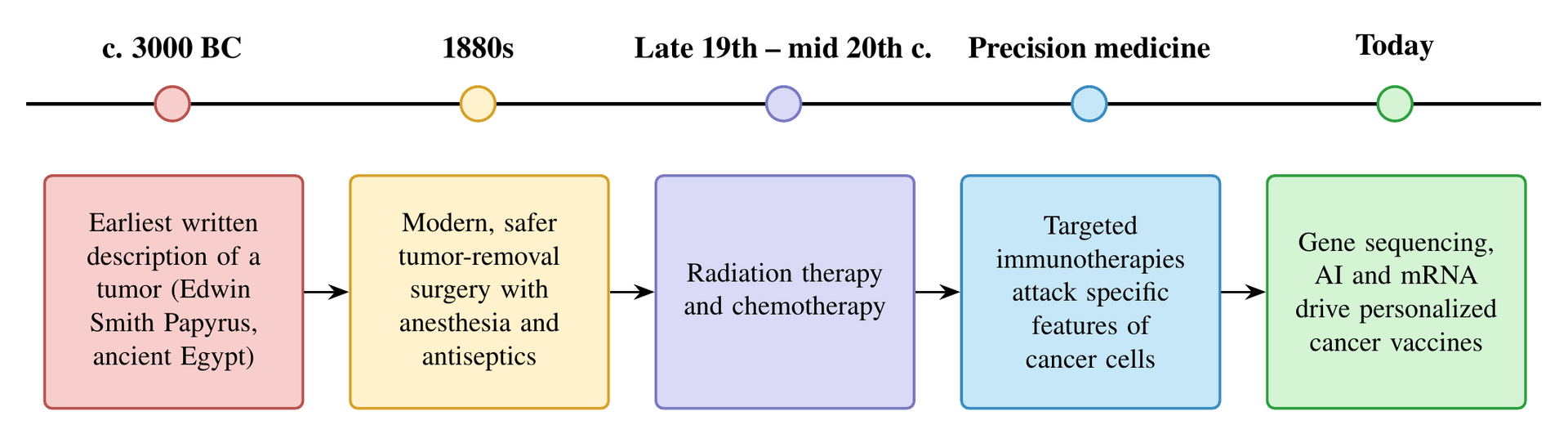
The earliest written description of cancer comes from ancient Egypt: the Edwin Smith Papyrus, dated to about 3000 BC [15]. Modern, and somewhat safe tumor removal surgeries truly began in the 1880s with the advent of anesthesia and antiseptics.
In the late 19th and early-mid 20th century, advances in medicine introduced radiation therapy and chemotherapy, which gave doctors more effective ways to kill tumors and cancer cells.
2.2 The Shift to Precision Medicine
As researchers learned that cancers differ at the genetic and molecular level, treatment shifted toward precision medicine. Targeted immunotherapies began to attack specific features of cancer cells or help the immune system fight cancer.
Today, advancements in gene sequencing, AI, and mRNA technology are driving the next step: personalized cancer vaccines, designed to train the immune system to recognize the unique and abnormal proteins synthesized by an individual's tumor.
3. The Problem with One-Size-Fits-All Cancer Treatment
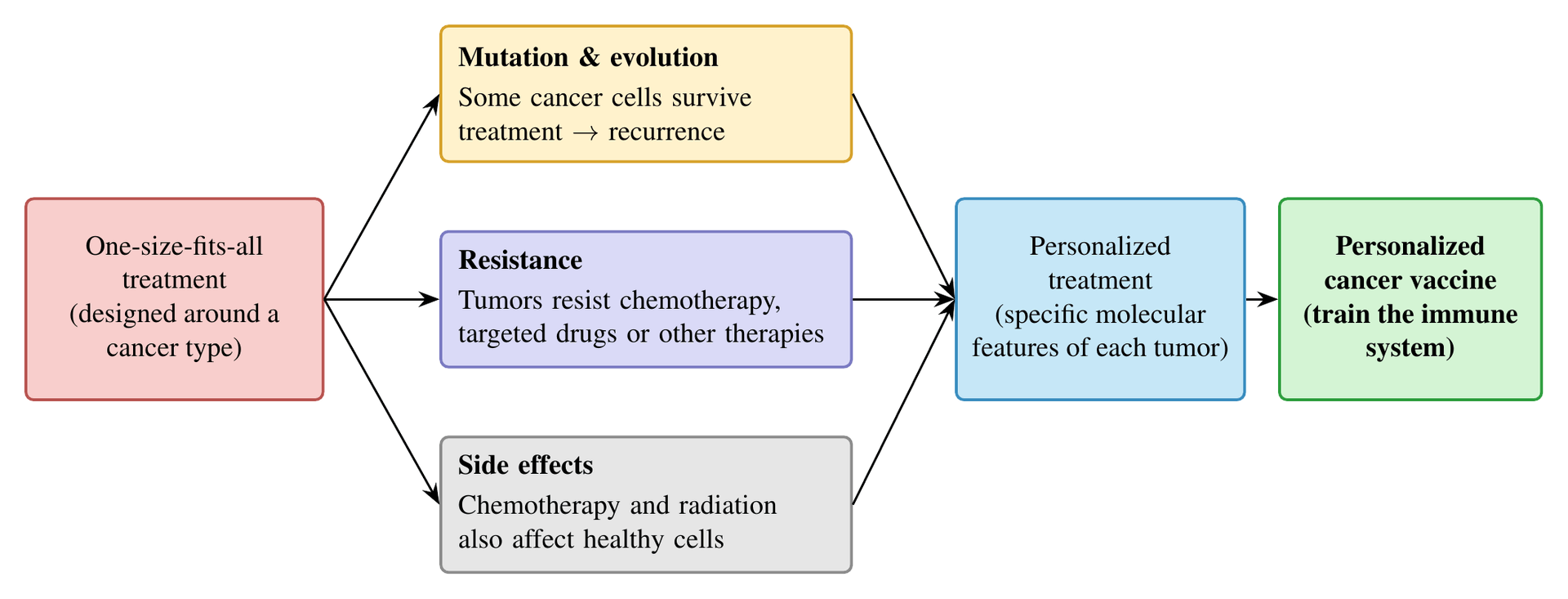
Cancer is not a single disease, and no two tumors are exactly alike. Even patients with the same type of cancer can have different genomic mutations and biological characteristics. Yet many traditional treatments are designed around the general characteristics of a cancer type rather than the unique features of an individual patient’s tumor.
3.1 Major Problems Faced
Cancer cells can undergo mutation and evolve, allowing some of them to survive treatment and eventually cause a recurrence. Some tumors also develop resistance to chemotherapy, targeted drugs, or other therapies. At the same time, treatments such as chemotherapy and radiation can affect healthy cells along with cancer cells, leading to significant side effects.
The Personalized Approach
This is where personalized cancer treatment becomes important. Instead of treating every patient’s cancer in the same way, researchers are exploring therapies that identify the specific molecular features of each tumor and use them as targets. Personalized cancer vaccines take this idea a step further by attempting to train the immune system to recognize the individual characteristics of a patient's cancer.
4. Neoantigens: Cancer’s Unique Fingerprints
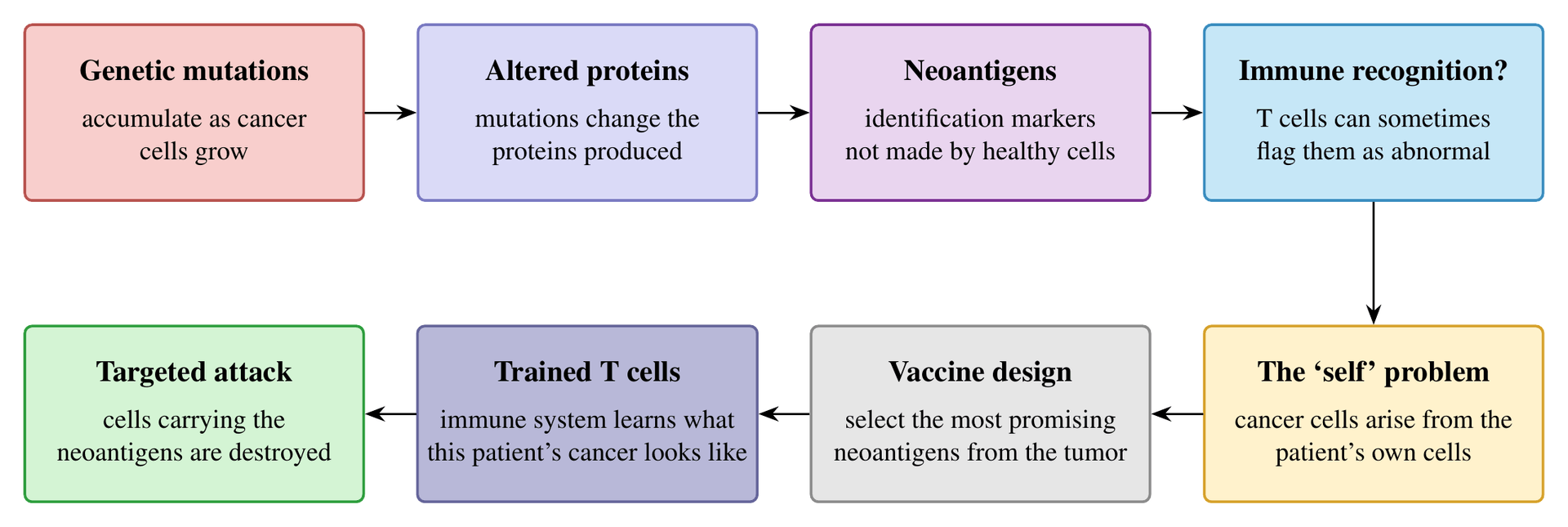
As cancer cells grow, they accumulate genetic mutations that can alter the proteins they produce. Some of these altered proteins create identification markers, called neoantigens, which are not normally created by healthy cells. Because these markers are often unique to a particular genetic mutation, they can act as fingerprints of cancer.
4.1 Why Cancer Hides in Plain Sight
The immune system can sometimes recognize these neoantigens as abnormal and activate T cells to attack cells carrying them. However, cancer cells are difficult for the immune system because the immune system cannot easily tell them apart from healthy cells. Unlike bacteria or viruses that arrive from the outside with completely foreign traits, cancer cells arise from the patient's own cells and share most of their genetic makeup with healthy cells. Because they resemble "self," the immune system struggles to recognize them as a threat. Personalized cancer vaccines aim to overcome this by selecting the most promising neoantigens from a patient's tumor and training the immune system to recognize them more effectively.
5. How Personalized Cancer Vaccines Work

5.1 From Biopsy to Blueprint
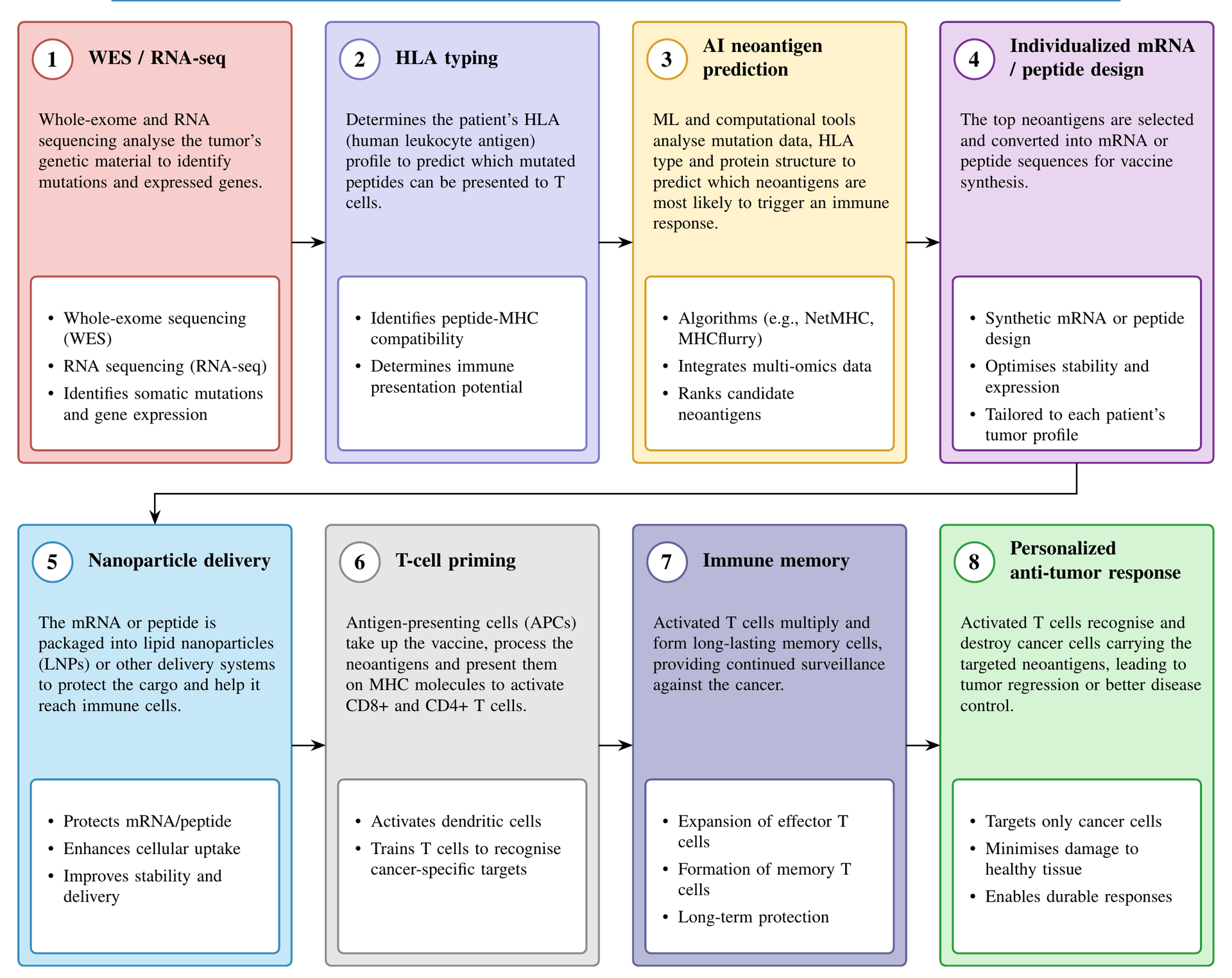
Personalized cancer vaccines are created through a highly individualized process that begins with analysis of the patient’s tumor. First, a tumor biopsy is performed and its genetic sequence is examined. Oncologists/Researchers then identify mutations that are unique to the cancer and determine which of them may produce recognizable neoantigens.
5.2 Designing the Vaccine
Using computational tools and immunological-response data, researchers select the most promising neoantigens and use them to design a personalized vaccine. The vaccine may use technologies such as mRNA or peptides to present these targets to the immune system.
5.3 Training the Immune System
Once administered, the vaccine helps activate T cells, teaching them what the patient’s cancer cells look like. These T cells can then locate and destroy cells carrying the selected cancer-specific targets.
6. Recent Advancements
6.1 Identifying the Targets
Reviews of neoantigen vaccines note that improved HLA class I epitope prediction, built on whole-exome sequencing, RNA sequencing, HLA typing and immunopeptidomics, has narrowed thousands of candidate neoepitopes to a few immunogenic mutations per patient [1]. Analyses of earlier trials, however, found that clear proof of efficacy has remained out of reach for most neoantigen vaccines [2].
6.2 Clinical Evidence
Personalized mRNA vaccination with autogene cevumeran in resected pancreatic cancer induced neoantigen-specific T cells in 8 of 16 patients, though within a small phase I cohort [3]. Follow-up of the same patients showed that most vaccine-induced T-cell clones persisted about 3 years after vaccination [4]. Combining mRNA-4157/V940 with pembrolizumab in high-risk melanoma improved 18-month recurrence-free survival over pembrolizumab alone (79% vs 62%), providing early randomized evidence for combining individualized mRNA neoantigen vaccines with immunotherapy, though the difference did not reach conventional significance (p = 0.053) [5]. A peptide-based vaccine generated T-cell responses in all 9 patients with high-risk kidney cancer despite a low tumor mutation burden, though in a nine-patient cohort [6], and in triple-negative breast cancer individualized mRNA vaccines were shown to elicit long-lasting T-cell responses to multiple neoantigens that remained functional for several years [7]. Most recently, the phase 3 INTerpath-001 trial of the melanoma combination met its primary recurrence-free survival endpoint [16], [17].
6.3 Open Questions
Three questions therefore remain open. First, can neoantigen selection reliably identify the mutations that are presented by HLA molecules and recognized by T cells? Second, can mRNA manufacturing and delivery become fast and scalable enough for routine care? Third, will larger randomized trials confirm that these vaccines help patients live longer?
7. AI, mRNA and the Science Behind the Breakthrough
7.1 From Sequencing Data to Neoantigens
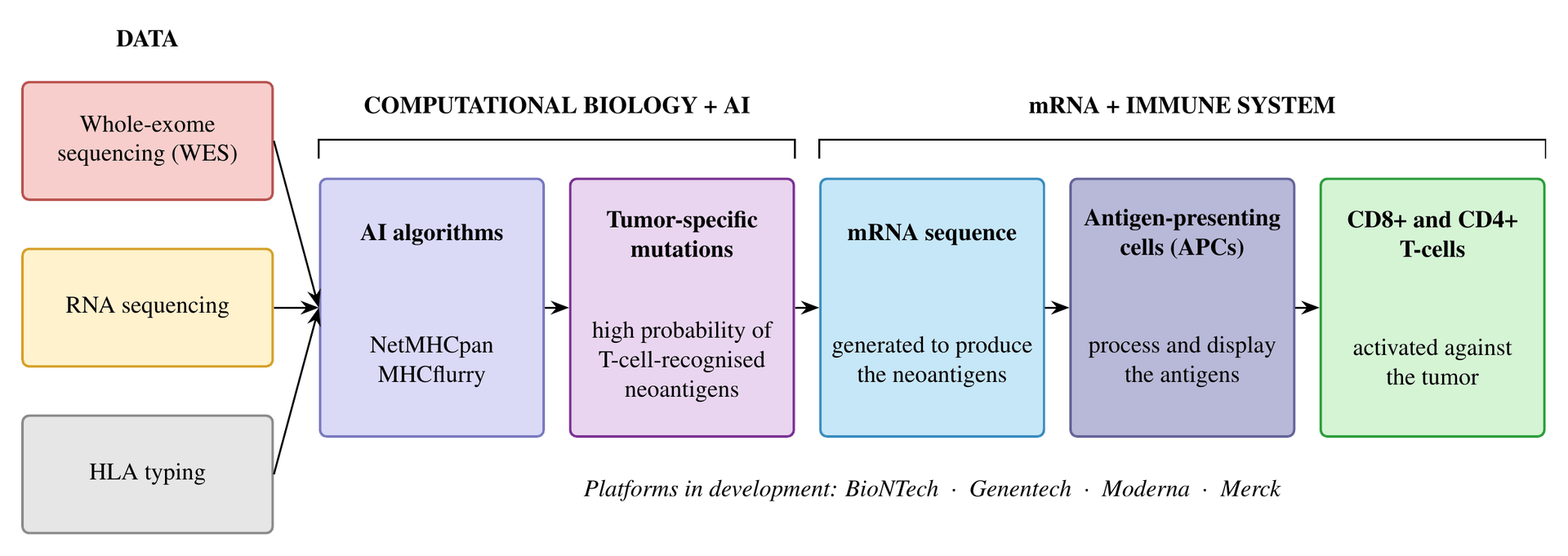
Computational biology and artificial intelligence (AI) assist researchers in identifying optimal genetic mutations within a given tumor. By utilizing data generated from whole-exome sequencing (WES), RNA sequencing and HLA typing; algorithms such as NetMHCpan and MHCflurry are employed to identify tumor-specific mutations that have a high probability of generating neoantigens that will be recognized by T-cells. Once the target mutations have been identified, the corresponding mRNA sequence can be generated to produce the neoantigens. Researchers can subsequently create individualized vaccines based on the mRNA sequences.
7.2 From mRNA to T-Cell Activation
mRNA sequences will serve as templates for producing tumor-specific antigens that are subsequently processed by antigen-presenting cells (APCs) and displayed to both CD8+ and CD4+ T-cells. Companies such as BioNTech, Genentech, Moderna and Merck are currently working on developing platforms that integrate these technologies for developing personalized cancer vaccines.
8. Benefits and Challenges of Personalized Cancer Vaccines
Personalized to each tumor - targeting a unique genetic marker created by that specific tumor
Spares healthy cells - kill cancer cells while largely leaving healthy cells unharmed
Uses the body's own defenses - train the patient’s own immune system to recognize and attack the specific tumor cells without damaging one's body
Highly specific target - instead of teaching the immune system to fight cancer in general, they teach it what that particular patient's cancer looks like
Long-lasting immunity - individualized mRNA vaccines help T cells recognize and fight multiple cancer markers, with these immune responses lasting for several years.
Works alongside immunotherapy - Early randomized trials have shown promising evidence that personalized mRNA vaccines can be used alongside immunotherapy to fight cancer.
Strong early results - early trials have clearly demonstrated that these vaccines show exceptional immune responses and clinical potential
9. Conclusion
Personalized cancer vaccines represent a major shift in oncology, from having a generalized treatment for cancer to targeting a unique genetic marker created by that specific tumor. By combining genome sequencing, neoantigen prediction, AI, mRNA technology, and immunotherapy, researchers are developing vaccines that can train the patient’s own immune system to recognize and attack the specific tumor cells without damaging the body.
Although challenges such as cost, manufacturing time, tumor heterogeneity and limited clinical data remain, early trials have clearly demonstrated that these vaccines show exceptional immune responses and clinical potential. As AI systems improve, sequencing becomes faster and more cost effective, and vaccine manufacturing becomes more scalable, personalized cancer vaccines could become an integral part of precision oncology.
The ultimate vision is simple yet transformative: instead of finding a treatment that works for cancer, design a treatment that works for the cancer in you.