01 INTRODUCTION
The Storage Crisis
The High Density Storage Equipment Market is set to grow rapidly by 2026 as industries - healthcare, finance, government, and cloud services generate more data than ever before. Companies are urgently seeking smarter, more space-efficient storage solutions to keep up.
Traditional storage writes data onto flat surfaces like hard drives, optical discs and struggles with modern workloads. Maintenance becomes expensive, and systems consume ever more space, power, and cost over time. Something fundamentally different is needed.
Holographic memory stores data throughout the entire volume of a medium using three independent properties of light - amplitude, phase, and polarization - simultaneously, achieving densities surface-based media cannot approach.
02 WHAT IS HOLOGRAPHIC DATA STORAGE?
Storing Data in the Thickness, Not the Surface
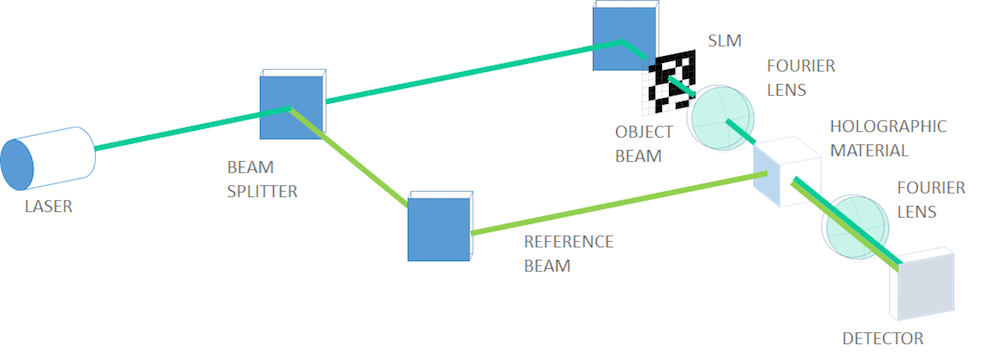
Holographic storage records interference patterns created when two laser beams meet inside a photosensitive material. Unlike HDDs or SSDs, which write data on a flat surface, it distributes entire pages of data, millions of bits throughout the full 3D volume in a single exposure.
The process splits a laser into two paths:
- Object beam - carries the data signal via a spatial light modulator
- Reference beam - provides the encoding key and phase reference
When these beams recombine, they form a hologram recorded as a change in the material's refractive index which is spread throughout the entire volume, not pinned to a surface location.
03 THE THREE DIMENSIONS OF LIGHT
Light Carries More Than You Think
A coherent light wave has three independently controllable properties, each serving as a separate data channel:
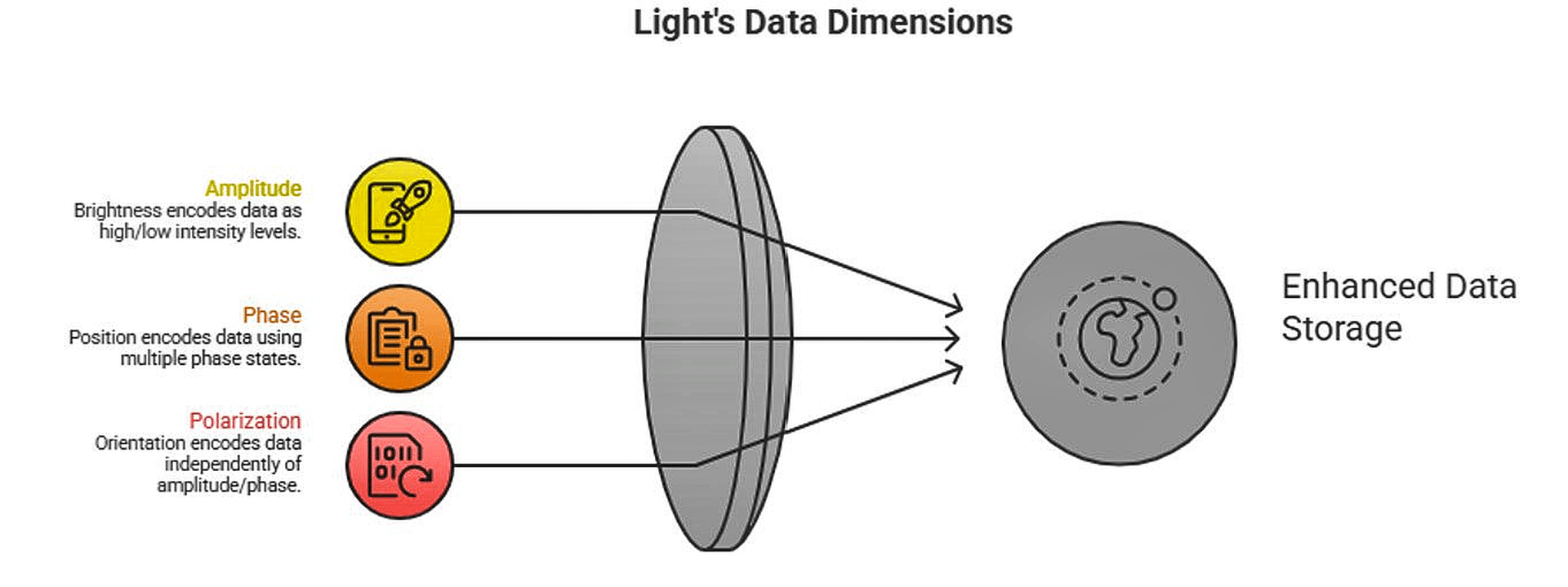
Combining all three is multiplicative, not additive. A system with 4 amplitude levels × 4 phase states × 2 polarization orientations encodes 5 bits per pixel - vs. 1 bit in a conventional system.
04 LIMITATIONS OF TRADITIONAL HOLOGRAPHIC SYSTEMS
Why Hasn't This Happened Already?
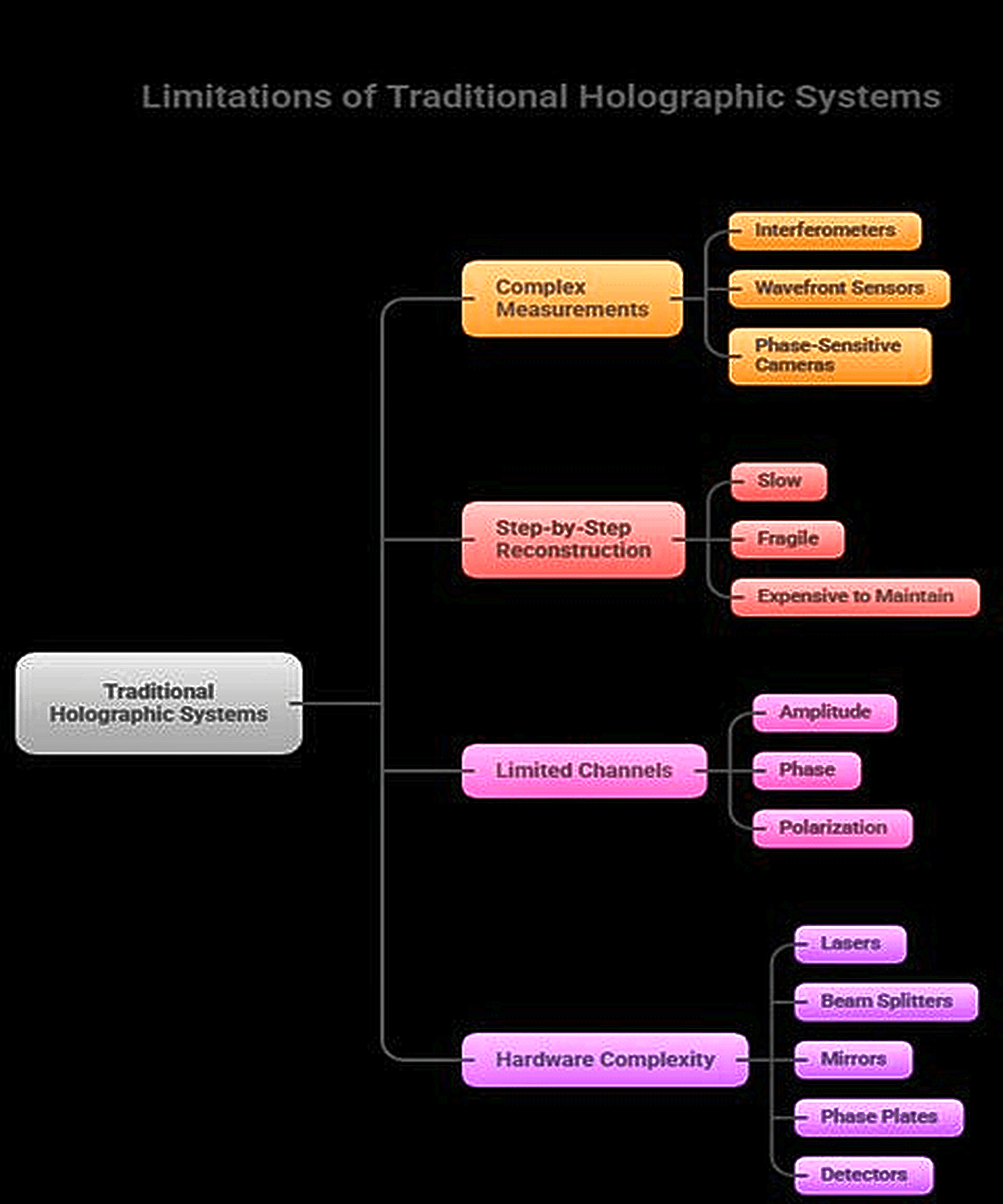
- Complex measurements - requires precise simultaneous measurement across the entire detector plane, demanding interferometers, wavefront sensors, and phase-sensitive cameras
- Step-by-step reconstruction - data retrieval requires physically reconstructing the optical wavefront step by step, making systems slow, fragile, and expensive to maintain
- Limited channels - most systems use only amplitude or phase, leaving polarization, an entire encoding dimension, completely untapped
- Hardware complexity - elaborate assemblies of lasers, beam splitters, mirrors, phase plates, and detectors make traditional systems lab instruments, not commercial products
05 ENTER ARTIFICIAL INTELLIGENCE
How CNNs Cracked the Decoding Problem
Convolutional Neural Networks (CNNs) solve holography's hardest problem computationally. Instead of engineering ever-more-precise optical hardware, a CNN trained on real detector data learns to map intensity readings directly to decoded data, compensating for system noise, drift, and misalignment automatically.
Pattern Recognition in Optical Fields
The CNN's convolutional layers act as spatial feature detectors, identifying patterns that correspond to encoded symbols. It learns the system's own imperfections and corrects for them.
Direct Decoding - No Reconstruction
The CNN performs end-to-end inference: detector pixels in, decoded data out. No intermediate wavefront is reconstructed. This eliminates interferometers, wavefront sensors, and phase plates entirely, dramatically reducing latency and hardware complexity.
"The CNN doesn't reconstruct the wavefront - it reads the data directly from the light pattern. Faster, simpler, and robust to perturbations that blocked practical holographic storage for decades."
06 POLARIZATION AS A NEW INFORMATION CHANNEL
The Hidden Dimension That Changes Everything
Researchers have combined polarization holography with a CNN to enable polarization as an independent information dimension - a first for practical holographic storage. Even a simple binary polarization channel (horizontal vs. vertical) doubles the bits encoded per hologram symbol relative to a two-channel amplitude+phase system.
Because polarization is physically orthogonal to the other two channels, data encoded there has zero cross-talk with amplitude or phase data. It can carry its own independent data stream - separated at readout using simple polarizing beam splitters or wave plates, or decoded jointly by the CNN.
"Polarization is not an upgrade to holographic storage - it is a new dimension of it."
07 3D MODULATION ENCODING STRATEGY
Encoding Data in Three Dimensions at Once
Every pixel in the holographic medium simultaneously encodes three independent values - one per channel. The result is a point in a 3D symbol constellation. Where a conventional system stores 1 bit per location, a 3D modulation system stores a vector.
| AMPLITUDE | PHASE | POLARIZATION |
|---|---|---|
| Intensity levels | Wave states | Orientation |
HIGH-DENSITY 3D HOLOGRAM
Each pixel encodes amplitude + phase + polarization simultaneously.
08 THE DOUBLE-PHASE HOLOGRAM BREAKTHROUGH
Making It Practical with Off-the-Shelf Hardware
Most SLMs are phase-only devices - they can't directly control amplitude. The double-phase hologram technique solves this elegantly: any complex optical field can be exactly decomposed into two phase-only fields, which are interlaced across adjacent SLM pixels. As the beam propagates, they interfere and reconstruct the full amplitude in the far field.
- No separate amplitude modulator required
- Works on commercially available phase-only SLMs today
- Polarization encoding added via a wave plate - no new optical architecture needed
The double-phase technique bridges the gap between theoretical 3D encoding and real hardware that already exists and is manufactured at scale.
09 ROLE OF THE SPATIAL LIGHT MODULATOR
The Programmable Heart of the System
A Spatial Light Modulator (SLM) is a programmable optoelectronic device that independently modulates the phase or amplitude of light at each of its millions of pixels - effectively a dynamic optical mask. Modern LCoS SLMs offer megapixel resolution and kilohertz refresh rates.
Using the double-phase technique, a single phase-only SLM generates the full 3D modulated field required for high-density holographic encoding.
10 ADVANTAGES
Why This Changes Everything
| Benefit | Impact |
|---|---|
| Higher Storage Capacity | 3D volume storage beats surface storage |
| Faster Data Retrieval | CNN decoding replaces slow reconstruction; terabit/s access |
| Reduced Hardware Complexity | Eliminates amplitude modulators, interferometers |
| Improved Efficiency | Fewer components, no moving parts, lower power per bit |
11 REAL-WORLD APPLICATIONS
Where This Technology Will Land First
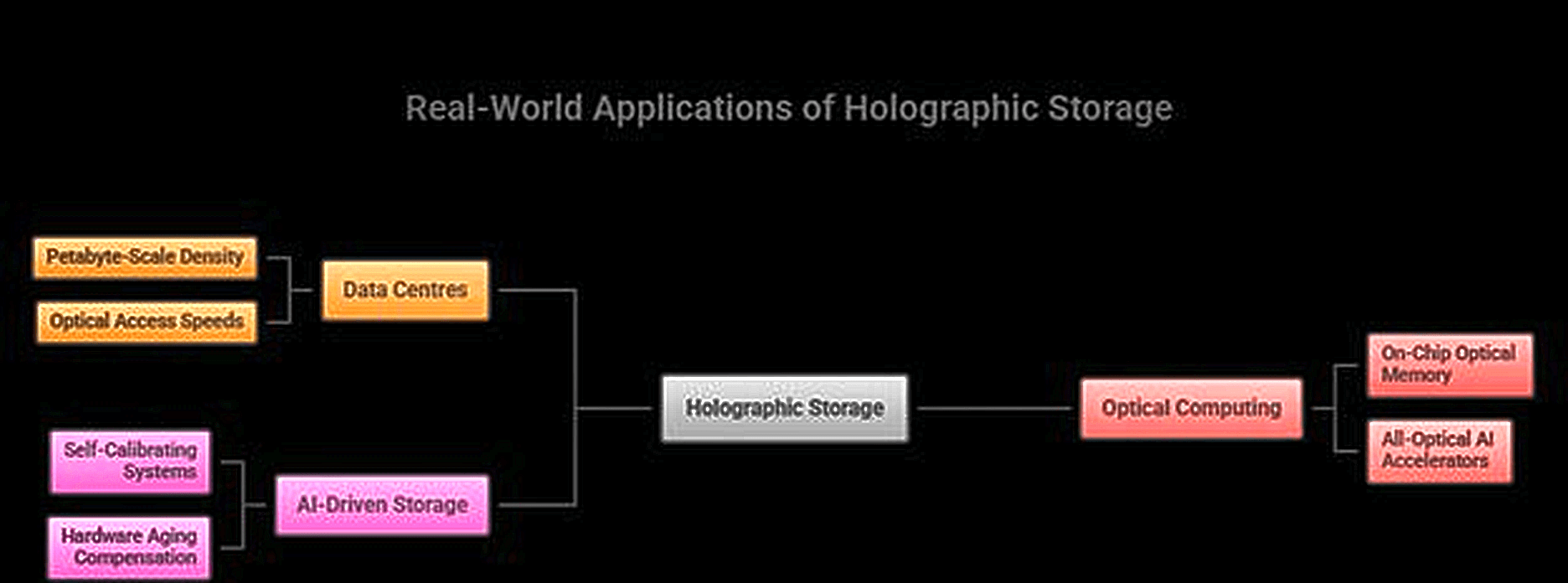
- Data Centres - Hyperscale providers need denser, faster cold-storage alternatives to tape. Holographic storage offers petabyte-scale density per rack unit at optical access speeds.
- Optical Computing - Photonic processors need on-chip optical memory accessible at light speed. Holographic memory integrates natively, enabling all-optical AI accelerators without electrical-optical conversion.
- AI-Driven Storage - CNN decoders improve with operational data, creating self-calibrating, adaptive storage systems that anticipate workloads and compensate for hardware aging automatically.
12 CHALLENGES AND FUTURE SCOPE
The Hurdles Still to Clear
- Hardware - Current SLM pixel pitches 3.5-8 μm limit hologram density; next-gen metasurface SLMs could reduce these to sub-wavelength scales.
- Scalability - Lab demonstrations at centimetre scales must be reproduced across industrial volumes. Photorefractive media uniformity and fatigue are open materials science challenges.
- Integration - Holographic systems must interface with SATA/PCIe/NVMe ecosystems. Error correction, file system support, and CNN driver software all need development.
These are engineering challenges - not scientific ones. The physics is proven; the path to commercialisation is a matter of sustained investment.
14 CONCLUSION
Why This Technology Matters
Holographic memory is not merely a denser hard drive. It is a qualitative shift in the relationship between light, information, and physical space. By encoding data across three independent optical dimensions and using machine learning to decode it, this technology opens a path to storage densities and access speeds no existing medium can approach.
The science is sound. The enabling technologies are advancing. The commercial need is urgent. And with AI now handling what optics alone could not, the final barriers are falling.
"Light is not just how we see - it is how we will store, process, and power the data-driven future."
REFERENCES
Primary Research
-
Tan, X., et al. (2026). Multidimensional holographic data storage combining amplitude, phase and polarization via CNN decoding. Optica, Optica Publishing Group. March 26, 2026.
https://www.optica.org/about/newsroom/news_releases/2026/new_holographic_data_storage_approach_packs_more_data_into_the_same_space -
Optics Photonics News. (2026, March). Neural Network Boosts Holographic Storage. Optica Publishing Group.
https://www.optica-opn.org/home/newsroom/2026/march/neural_network_boosts_holographic_storage -
EurekAlert! AAAS. (2026, March). New holographic data storage approach packs more data into the same space.
https://www.eurekalert.org/news-releases/1121069 -
ScienceDaily. (2026, March). Scientists just found a way to store massive data using light in 3 dimensions.
https://www.sciencedaily.com/releases/2026/03/260328212132.htm -
SciTechDaily. (2026, March). This Multidimensional Holographic Breakthrough Stores Massive Data Inside Light Itself.
https://scitechdaily.com/this-multidimensional-holographic-breakthrough-stores-massive-data-inside-light-itself
Double-Phase Hologram SLM Technology
6. Zhang, H., et al. (2020). Reducing the crosstalk effect in phase-only SLMs based on double-phase method. Optics and Lasers in Engineering. Elsevier.
https://www.sciencedirect.com/science/article/abs/pii/S0030401820301863
-
Yamaguchi, T., et al. (2022). Complex spatial light modulation capability of a dual layer in-plane switching liquid crystal panel. Scientific Reports, Nature Portfolio.
https://www.nature.com/articles/s41598-022-12292-4 -
Hsueh, C.K., Sawchuk, A.A. Optimal synthesis of double-phase computer generated holograms using a phase-only SLM with grating filter. Applied Optics / ResearchGate.
https://www.researchgate.net/publication/235415318
Data Growth Market Statistics
-
IDC Seagate. Data Age 2025: The Digitization of the World - From Edge to Core. IDC White Paper. CAGR of 23% in global data creation 2020-2025, reaching 180 zettabytes by 2025.
https://www.networkworld.com/article/966746/idc-expect-175-zettabytes-of-data-worldwide-by-2025.html -
Statista IDC. (2024). Volume of data created, captured, copied, and consumed worldwide 2010-2023, with forecasts to 2028. Updated May 2024.
https://www.statista.com/statistics/871513/worldwide-data-created