Introduction
Satellite quantum communication is often modeled with high precision at the system level—covering source characteristics, detection mechanisms, and protocol behavior. In contrast, the atmosphere is frequently treated using simplified assumptions: standard profiles, fixed parameters, and averaged conditions.
This imbalance introduces a critical gap.
The atmosphere is not a static layer. It is a spatio-temporally varying system whose properties depend strongly on geography, altitude, and environmental conditions.
This raises an important research question:
To what extent do simplified atmospheric models misrepresent real channel behavior in satellite quantum links?
The Atmospheric Channel as a Coupled System
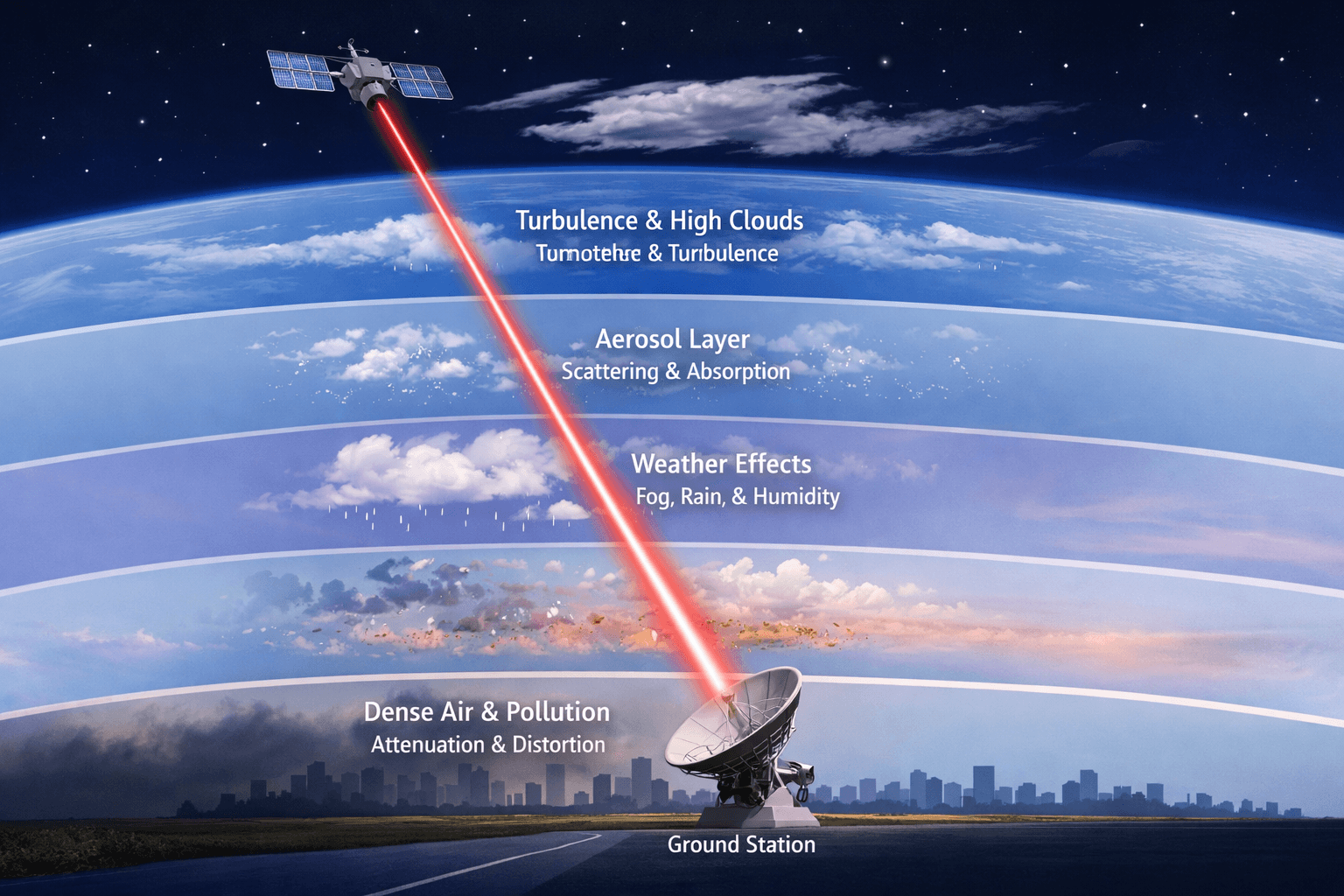
Optical signals propagating from space to ground traverse a heterogeneous medium characterized by multiple interacting effects:
- Aerosol loading (dust, pollutants, particulates)
- Turbulence-induced refractive index fluctuations
- Molecular scattering and absorption
- Altitude-dependent density gradients
These effects are inherently coupled.
For instance, variations in aerosol concentration influence scattering properties and can modify the effective impact of turbulence along the propagation path. Similarly, altitude-dependent changes affect both attenuation and phase distortion simultaneously.
Thus, the atmospheric channel cannot be accurately described as a superposition of independent impairments. It must be treated as an interacting system.
Limitations of Conventional Modeling Approaches
Most existing models rely on simplifying assumptions such as:
- Standard atmospheric profiles (e.g., mid-latitude models)
- Fixed or averaged aerosol parameters
- Decoupled attenuation and turbulence formulations
While these approaches are analytically tractable, they introduce structural limitations:
- Lack of geographic specificity
- Inability to capture temporal variability
- Oversimplified representation of slant-path propagation
As a result, these models may yield performance estimates that do not generalize to real-world conditions.
Revisiting Dominant Impairments
A common assumption in free-space optical and quantum communication is that turbulence is the primary limiting factor.
However, this assumption does not consistently hold under realistic environmental conditions.
In regions with elevated particulate matter, aerosol-induced attenuation can become comparable to—or even exceed—turbulence-related losses. Conversely, in cleaner atmospheres, turbulence may dominate.
This indicates that dominant impairment mechanisms are environment-dependent rather than universal.
Therefore, performance analysis based on fixed assumptions about dominant effects can lead to misleading conclusions.
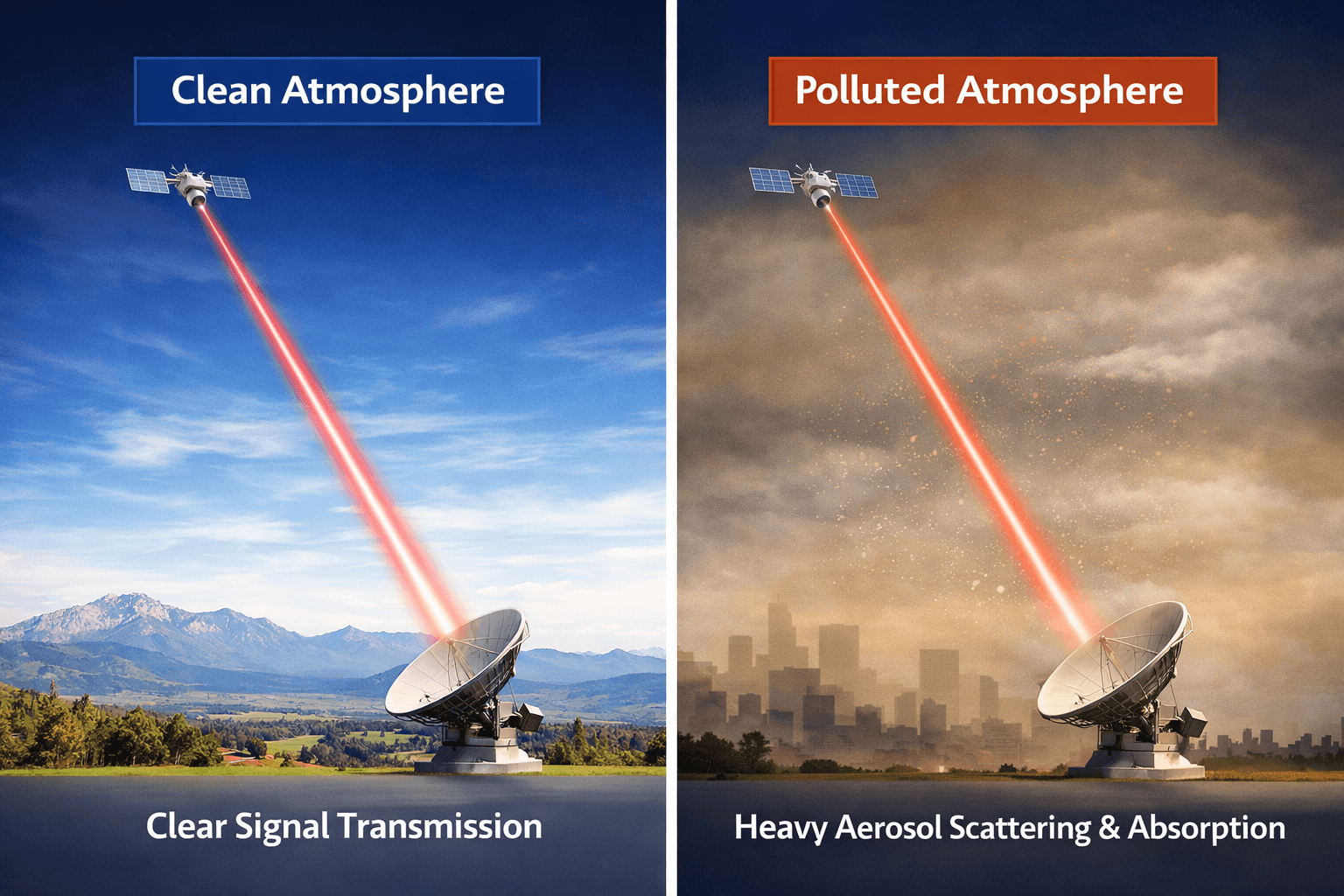
Toward Climatology-Aware Channel Modeling
A more accurate representation of the atmospheric channel requires integration of real atmospheric data into propagation models.
Key elements of such an approach include:
- Use of reanalysis datasets or observational atmospheric data
- Location-specific parameterization of aerosols and weather conditions
- Dynamic modeling of slant paths based on geometry
- Joint treatment of interacting effects rather than isolated components
This paradigm—often referred to as climatology-aware modeling—enables a more realistic characterization of channel behavior.
Importantly, it reveals dependencies and performance variations that are not captured by conventional models.
Implications for Quantum Communication Systems
In satellite quantum communication, system performance is highly sensitive to channel loss and fluctuations.
Even modest inaccuracies in atmospheric modeling can lead to:
- Errors in link budget estimation
- Misinterpretation of experimental results
- Suboptimal placement of ground stations
A data-driven atmospheric model allows for:
- More reliable prediction of key rates and losses
- Improved system design under realistic constraints
- Better alignment between theoretical models and deployed systems
Broader Perspective
The persistence of simplified atmospheric models is largely driven by analytical convenience.
However, as system precision increases, the cost of these simplifications becomes more significant.
The atmosphere should not be treated merely as a source of attenuation or noise. It is a structured and evolving component of the communication channel that directly influences system behavior.
Conclusion
Accurate modeling of satellite quantum communication systems requires a shift in how the atmosphere is treated.
Static, generalized assumptions are insufficient for capturing real-world behavior.
A climatology-aware, data-driven approach provides a more faithful representation of atmospheric effects and their impact on signal propagation.
If the atmosphere defines the channel, then simplifying it is not just an approximation—it is a source of systematic error.
Advancing toward realistic atmospheric modeling is therefore not optional, but essential for the development of reliable quantum communication systems.